RGNL-60 Casement Window China Supplier Glass Specifications
The RGNL-60 product table lists several glass families and one double-glazing notation. Buyers should convert those entries into one pane-by-pane schedule before comparing a China supplier’s quotation or approving production.
Turn the Published Glass List into an Order Specification
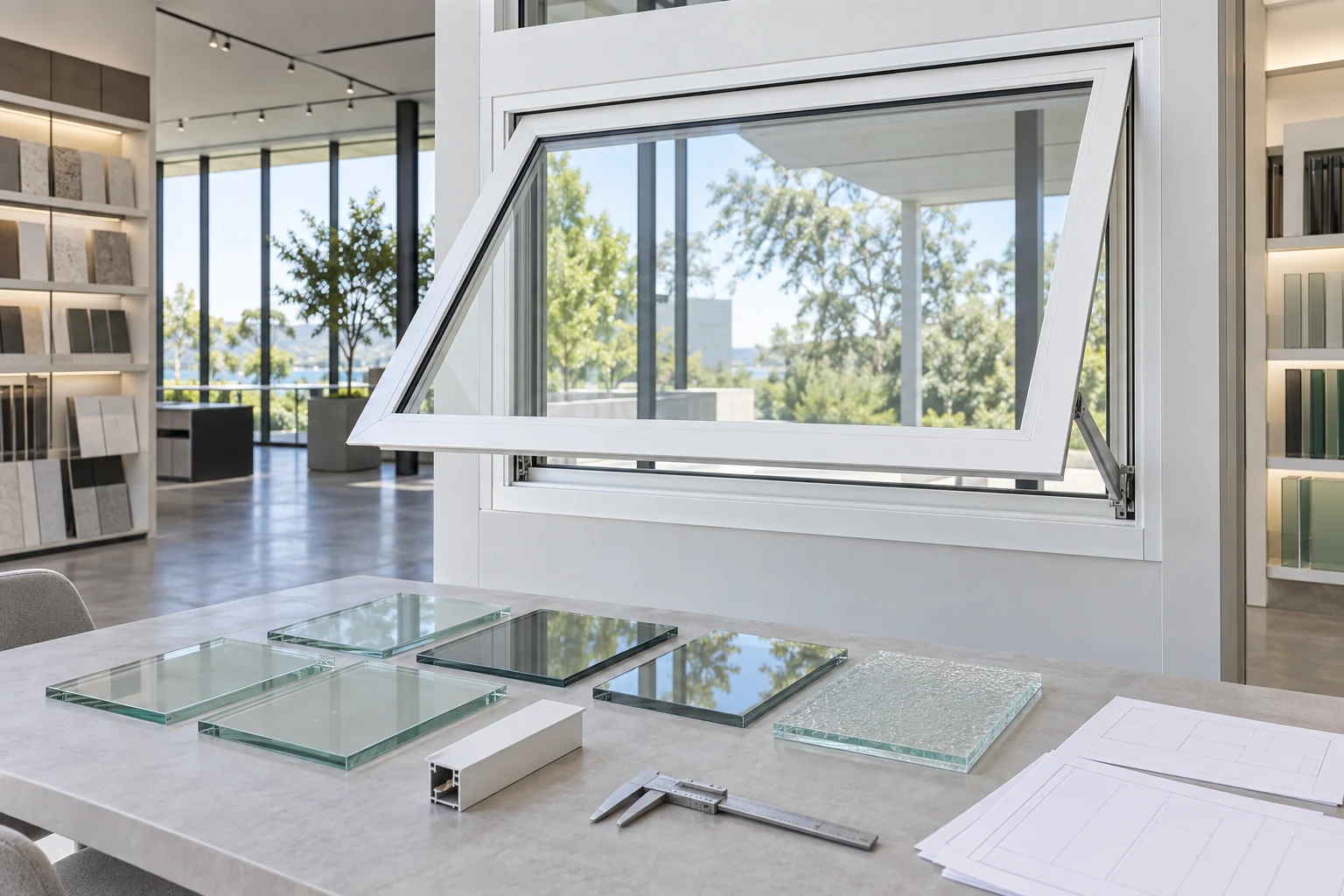
The official RGNL-60 Series Aluminum Casement Windows page contains a structured table that identifies an RGNL-60 thermal-break awning-window configuration. It is publicly assigned to the Casement Windows product category.
The page lists glass families, not one universal glazing package for every sash or project. A controlled RFQ should link one complete make-up to every window mark, opening mode and drawing revision. This dedicated glass review is separate from the existing articles on approval documents, hardware selection and installation interfaces.
RGNL-60 Quick Specs and Glass Controls
| Item | Published RGNL-60 data | Buyer control |
|---|---|---|
| Product basis | RGNL-60 Series Aluminum Casement Windows; table identifies a thermal-break awning window | Keep the exact product URL and selected opening mode on the schedule |
| Frame basis | 60 mm system; 6063-T5 thermal-break aluminum; 1.6 mm thickness | Match the returned section to the approved window mark |
| Glass families | Tempered; double or triple tempered; laminated, Low-E, reflective or tinted | Select one full pane-by-pane build-up |
| Published notation | Double glazing tempered, 5 mm + 15Ar + 5 mm | Ask the supplier to define every layer and the cavity notation in writing |
| Surface treatments | Powder coating, anodized, wood grain or PVDF coating | Coordinate glass appearance with the approved frame sample |
| Opening modes | Inward, tilt-and-turn, outward or awning | Confirm sash size, mode and glass mass together |
The source notation is preserved as published. It does not by itself confirm a coating face, spacer, gas concentration, safety marking, performance value or suitability for every unit.
Compare the Published Glass Families
Tempered Glass
Tempered glass is listed. The RFQ should still identify which panes are treated, their thicknesses, required markings and the project basis for the selection.
Double or Triple Tempered
This is a published family description, not a complete insulating-glass build-up. Require all panes, cavities, spacers and treatments in the returned schedule.
Laminated Glass
Laminated glass is listed as an option. Define pane thicknesses, interlayer type and thickness, position within the assembly and edge requirements.
Low-E, Reflective or Tinted
These options are listed, but the product table does not fix coating type, face, tint or appearance. Approve a written proposal and a physical sample where visual consistency matters.
Glass Selection and Approval Logic
- Assign a unique glass code to each window type and drawing mark.
- Write every build-up from exterior to interior using one convention.
- Identify tempered or laminated treatment for each applicable pane.
- State coating or tint, location, appearance reference and sample requirement.
- Coordinate glass mass with the selected opening mode and returned sash proposal.
- Request applicable data or reports for the exact proposed configuration.
- Freeze the accepted glass schedule with the window drawing revision.
The official table does not publish universal sash-size limits or project performance values. Those items require product-specific review against the submitted dimensions and requirements.
Normalize the Glass Return Before Comparing Quotes
Use one comparison sheet for pane thicknesses, treatment, laminate, cavity, spacer, coating, tint, dimensions, quantity, sample scope, required documents, inspection, packing and delivery. Ask each supplier to identify substitutions and exclusions by glass code.
A quotation described only as “double glass” cannot be compared with a complete 5 mm + 15Ar + 5 mm return. Keep the schedule revision and notation convention consistent across every offer.
What Changes the Glass Quote?
Quoted scope can change with the selected glass family, complete pane build-up, laminated interlayer, coating or tint, pane dimensions, sash configuration, quantity, sample approval, inspection, edge protection, packing and delivery basis.
No public unit price, minimum order, lead time, glass performance value or freight rate is claimed here. Request those commercial items against the same approved technical package.
RFQ Inputs for a Comparable Glass Schedule
- Project location and destination requirements
- Window marks, dimensions and quantities
- Opening mode and viewing side
- Exterior-to-interior glass build-up
- Tempered or laminated treatment per pane
- Interlayer type and thickness where applicable
- Coating or tint, position and sample reference
- Required data sheets, reports and markings
- Substitution and approval process
- Inspection, packing and delivery basis
Send the window and glass schedules to Rogenilan for a product-specific return.
RGNL-60 Glass Specification FAQ
Which glass families are published for RGNL-60?
The official table lists tempered, double or triple tempered, laminated, Low-E, reflective and tinted glass families.
What double-glazing notation is listed?
The page publishes 5 mm + 15Ar + 5 mm. Ask the supplier to define every layer and the cavity notation in writing before approval.
Does that notation apply to every RGNL-60 window?
No. It is a listed option, not a universal project default. Confirm the glass build-up for every window mark and opening configuration.
How should Low-E or tinted glass be specified?
State the full build-up, coating or tint, position, appearance reference and required documents. Approve a physical sample when appearance is important.
What is needed for comparable quotations?
Use the same window schedule, pane build-ups, treatments, coatings, dimensions, quantities, documents, inspection, packing and delivery basis. Record all alternatives separately.
Request an RGNL-60 Glass Specification Review
Share the window schedule, opening modes, full glass make-ups, coating or tint references, required documents, quantities and destination. Rogenilan can return the proposed glass configuration against one controlled RFQ.