Wood Grain Aluminum Entry Doors China Supplier Corner Review
For a wood-grain aluminum entry-door enquiry, approve the pattern direction and its boundaries on an assembled detail, not only a flat color coupon. Ask the China supplier to identify which faces receive the proposed finish and show what happens where vertical members, horizontal members and panel edges meet.
Separate a Finish Family From an Approved Pattern
The official RGNL-100 Heavy Aluminum Plate Entry Door table lists wooden grain among its surface-treatment families. It does not define a wood species, pattern code, grain repeat, processing method or finish coverage for every part. Confirm those details for the actual order.
A directional pattern needs an orientation decision as well as a color decision. A coupon can show the proposed tone and texture on one face, but it cannot demonstrate an assembled corner, the side of a leaf or the boundary between two different materials. Use a marked elevation to locate these questions before requesting samples.
Verified Product and Finish Scope
| Published product entry | Record with the appearance request |
|---|---|
| RGNL-100 aluminum entry door; 100 mm frame reference | Exact section and door mark, separate from overall unit dimensions. |
| 6063-T5 aluminum; 2.0-4.0 mm listed thickness range | Which members and faces the proposed finish covers. |
| Aluminum honeycomb board or double glazing listed for the middle section | Identify the actual infill material and its separate appearance reference. |
| Wooden grain, powder coating, anodized and PVDF routes listed online | One confirmed route and pattern, with any contrasting components identified. |
| Single, unequal-double and double-door opening modes | Grain arrows and visible-face marks for the selected arrangement. |
The product is currently filed in the Casement Doors category. A wood-look image does not establish the infill material, coating process or an available pattern.
Choose the Sample That Answers the Question
| Requested submission | Useful review | Still unresolved |
|---|---|---|
| Flat finish coupon | Pattern reference, tone, sheen and texture on a named face. | Corners, edges and the full entrance. |
| Fabricated corner or panel-edge sample | Direction changes, finish boundaries and joint appearance. | The visual balance of the complete entrance. |
| Leaf or entrance mock-up, if agreed | Pattern scale, adjacent parts and viewing from both sides. | Other units or later changes. |
These are buyer-requested review levels, not a published standard sample service. Agree feasibility, size, cost and the question each submission must resolve before ordering it.
Map Wood-Grain Direction Before Corner Review
Use arrows to show the preferred direction on each visible component. Label the exterior and interior elevations; an arrow without a viewed-side reference can be misunderstood.
- Vertical frame and leaf members: identify the principal face and any visible side return.
- Horizontal members: mark the requested direction independently rather than copying an arrow from the vertical part.
- Infill panel: record its own material, pattern reference and orientation.
- Upper corner and panel boundary: identify the actual joint to reproduce in the sample.
- Leaf edge and meeting area: show what becomes visible when the door opens.
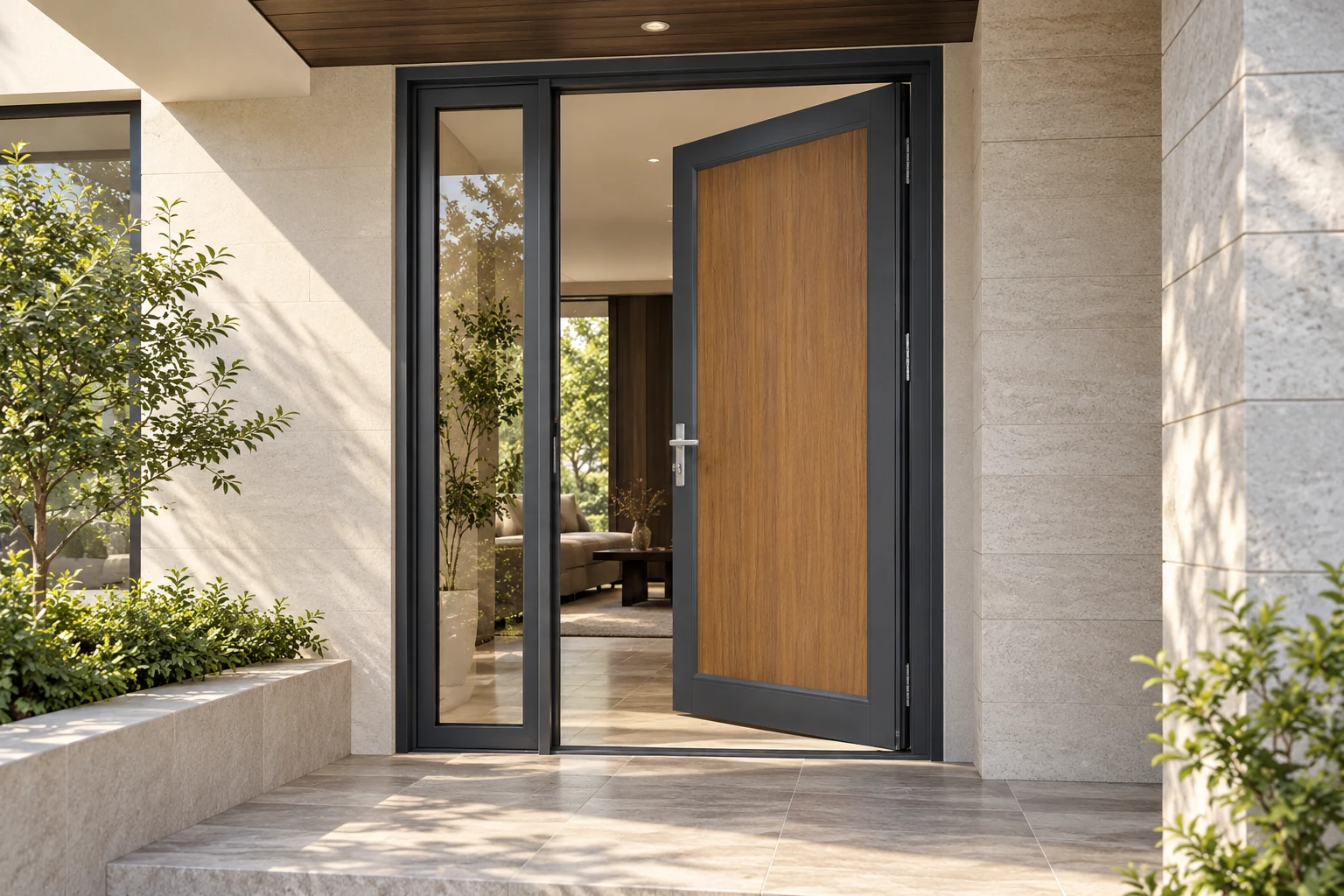
For a hypothetical entrance with a gray frame and a wood-look panel, approving the panel coupon does not approve a wood-grain frame. The face map should explicitly retain the gray members and name the panel treatment separately.
Record the Corner Decision in Words
Compare the actual sample against the marked drawing. Describe whether the pattern changes direction at the joint, stops at a boundary or continues onto a return. Record any visible mismatch as an observation, then request an achievable proposal. Do not infer continuous grain or matched pairs from a rendering.
Approve the sample only for the named components and viewing sides. Keep the sample ID, drawing revision, photographs locating the detail, reviewer and decision together. A revised panel layout or finish process should trigger a review of the affected detail.
Price the Review Scope Separately
Ask for separate lines for the proposed finish, coupon, fabricated detail, resubmissions and any agreed mock-up. State whether contrasting frames, infill faces, leaf edges and trims are included. This prevents approval of one sample from silently expanding the finished area. No sample fee, minimum quantity, production time, finish warranty or matching tolerance is established by the cited product table.
Send a Corner-Focused Enquiry
Include door marks, dimensions, quantities, selected opening mode, elevations, grain arrows, material boundaries, finish reference and the joints to sample. Identify the approval owner, required evidence and destination. Request a returned face map and sample proposal with unresolved items visible before commercial approval becomes production approval.
Wood-Grain Entry Door Questions
Does the RGNL-100 page list wood grain?
Yes. Its online table lists wooden grain as a finish family. Confirm the actual process, pattern and component coverage for the order.
Does a flat coupon approve the corner?
It represents the submitted face. Request an assembled detail when the direction or boundary at a corner matters.
Can grain be assumed continuous around a joint?
No such capability is established by the public table. Ask for the proposed detail and review the physical submission.
Can the illustration approve color or material?
No. Use it to discuss locations; approve the actual material and finish against identified physical references.
Review the Finish at the Actual Joint
Send Rogenilan the door elevation and marked appearance details for an order-specific sample proposal and quotation.