Understanding the true cost of stacking doors requires looking beyond the per-square-meter price tag. Hidden costs in shipping, installation, maintenance, and energy consumption can add 30-50% to your initial investment. Here’s a transparent cost breakdown that procurement teams can use for accurate budgeting.
Stacking Doors — Cost Breakdown and ROI Analysis
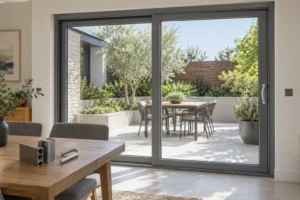
Stacking Doors (also called multi-stack doors) feature multiple panels that slide and stack in parallel, creating a clear opening without the folding mechanism of bi-fold doors.
Factory Direct Pricing — What Drives the Cost
Stacking Door System Specifications
Heavy-duty thermal break aluminum 6063-T6, 2.0-3.0mm wall thickness, parallel tracking system, PA66 GF25 thermal break, reinforced top rail or bottom track, multi-panel coupling
Price Range by Specification Tier
| Tier | Profile Wall | Glass Type | Hardware | Price Range (FOB) | Best For |
|---|---|---|---|---|---|
| Economy | 1.4mm | 5+12A+5 double | Standard Chinese | $80-$120/sqm | Budget projects, basic residential |
| Mid-Range | 1.6-1.8mm | Low-E double glazed | ROTO basic series | $120-$180/sqm | Standard residential, small commercial |
| Premium | 2.0mm+ | Triple/Low-E | SIEGENIA/Winkhaus | $180-$250/sqm | High-end residential, commercial |
| Custom | 2.0mm+ | Specialized | Configured | Quote on request | Special projects, architectural |
Total Cost of Ownership — 20-Year Comparison
| Cost Component | Economy Option | Premium Option | Notes |
|---|---|---|---|
| Initial Purchase | $80/sqm | $200/sqm | Per square meter |
| Installation | $15-25/sqm | $15-25/sqm | Similar for both |
| Shipping | $5-10/sqm | $5-10/sqm | Volume-dependent |
| Maintenance (20yr) | $20-40/sqm | $5-10/sqm | Premium hardware lasts longer |
| Energy Savings (20yr) | Baseline | $15-30/sqm saved | Better U-value = lower HVAC |
| **Total 20-Year Cost** | **$120-155/sqm** | **$225-245/sqm** | Premium pays back via durability |
Hardware Cost Impact
Top-hung pivots or bottom-rolling wheels, multi-point interlock handles, EPDM seals between panels and perimeter, security bolts, optional integrated screens and blinds
Stacking vs Bi-Fold — Key Differences
| Feature | Stacking Doors | Bi-Fold Doors |
|---|---|---|
| Movement | Parallel sliding | Hinged folding |
| Stack position | Behind adjacent panel | To the side |
| When fully open | Some panels always block | Full clear opening possible |
| Seal pressure | Consistent | Variable (hinge-dependent) |
| Maintenance | Lower (no hinges) | Medium (hinge adjustment) |
| Best for | Clean sightlines, frequent use | Maximum opening, occasional use |
Seal Performance Comparison
Stacking doors maintain consistent compression seals because panels don’t hinge — they slide parallel. This means:
- More consistent air tightness over the product lifetime
- Less seal wear (no hinge movement stress)
- Better long-term water tightness
Real-World Application Scenarios
Real-World Application Scenarios for Stacking Doors
Stacking Doors offer a cleaner alternative to bi-fold doors for wide openings where consistent sightlines matter:
Luxury Oceanfront Homes: Stacking doors with 4-6 panels create floor-to-ceiling glass walls that stack neatly behind each other. The parallel stacking system maintains clean sightlines when partially open.
Restaurant Indoor-Outdoor Dining: Unlike bi-fold doors, stacking doors maintain consistent compression seals across all panels. This means better weather tightness for restaurants in variable climates.
Conference & Event Venues: Stacking doors enable flexible room configurations. Multiple panels can be opened or closed independently to adjust space size for different event requirements.
Penthouse & Rooftop Terraces: Top-hung stacking systems with no bottom track provide the cleanest threshold for wheelchair accessibility while maintaining the full-width opening experience.
Maintenance & Long-Term Care
Maintenance & Long-Term Care for Stacking Doors
Top-Hung Pivot Maintenance: Top-hung stacking doors carry all panel weight from the top rail. Check pivot bearings annually and lubricate with silicone spray. Worn pivots cause panels to sag and drag.
Track Cleaning: Even bottom-rolling stacking systems require clean tracks. Vacuum debris and wipe with a damp cloth quarterly. For outdoor installations, check that drainage channels remain clear.
Inter-Panel Seal Inspection: Stacking doors rely on compression seals between adjacent panels. Check seals annually for compression set or tearing. Replace seals in complete sets for consistent performance.
Market Trends & Industry Insights
Global Market Trends
Stacking Doors are gaining market share in premium applications:
- Clean sightline preference — architects and homeowners increasingly choosing stacking over bi-fold for the cleaner parallel stacking profile
- Top-hung accessibility — barrier-free threshold requirements in commercial and multi-family residential driving top-hung stacking system adoption
- Panel size increasing — larger individual panels (up to 2,000mm wide) reducing the number of panels needed for wide openings
Shipping and Logistics Cost Guide
Container Loading Efficiency:
- 20ft container: ~80-120 sqm of stacking doors (depends on sizes and packing)
- 40ft container: ~180-250 sqm
- 40HQ container: ~220-300 sqm
Freight Cost Estimates (subject to market rates):
| Destination | 20ft (USD) | 40ft (USD) | Per sqm Cost |
|---|---|---|---|
| Southeast Asia | $800-1,200 | $1,500-2,000 | $4-8/sqm |
| Middle East | $1,000-1,800 | $2,000-3,000 | $5-12/sqm |
| Australia | $1,200-2,000 | $2,200-3,500 | $6-14/sqm |
| North America | $2,500-4,000 | $3,500-6,000 | $10-20/sqm |
| Europe | $1,500-2,500 | $2,800-4,000 | $8-16/sqm |
Payment Terms and Financial Protection
Recommended payment structures:
- T/T (Telegraphic Transfer): 30% deposit, 70% against B/L copy — most common
- L/C (Letter of Credit): Safest for large orders ($50,000+), adds ~0.5% bank fee
- Trade Assurance (Alibaba): Buyer protection up to insured amount
- Escrow services: Available for orders $5,000-$50,000
Avoid: 100% advance payment, wire transfer to personal accounts, suppliers refusing trade assurance.
Import Duty & Tax Guide by Region
Understanding the total landed cost of stacking doors requires factoring in import duties and taxes:
North America (US/Canada): Aluminum windows and doors typically face 0-5% import duty from China (varies by product classification and trade agreements). Additional state/provincial sales taxes apply. Section 301 tariffs may add 25% for certain aluminum products — check current trade policy.
European Union: Import duty of 0-4.5% depending on product classification. VAT (17-27% depending on country) applies to the total value including duty and shipping. Anti-dumping duties may apply to certain aluminum products from China — verify current status before ordering.
Australia: Import duty of 0-5% for aluminum windows and doors. GST (10%) applies to the total landed cost (product value + shipping + insurance + duty).
Middle East: Most GCC countries have 0-5% import duty. No VAT in some countries; 5% VAT in UAE and Saudi Arabia.
Southeast Asia: Varies by country — ASEAN members may have 0% duty under ATIGA for qualifying products. Check local trade agreements and preferential tariff schedules.
Total Landed Cost Calculator
To compare factory-direct pricing with local supplier quotes, calculate the total landed cost:
- FOB Price: × total sqm = product cost at Chinese port
- Sea Freight: Container cost ÷ total sqm = per-sqm shipping
- Insurance: ~0.3% of product value
- Import Duty: FOB + freight × duty rate
- VAT/GST: (FOB + freight + duty) × tax rate
- Port Handling: $200-500 per container
- Inland Trucking: $300-1,500 depending on distance
Formula: Total landed cost per sqm = (FOB + freight + insurance + duty + VAT + port + trucking) ÷ total sqm
Even after adding all these costs, Chinese factory-direct pricing typically saves 20-40% compared to local suppliers.
What Our Clients Say
> “We specialise in period property renovations. Rogenilan’s ability to match traditional aluminium profiles while delivering modern thermal performance has been invaluable. Their wood grain transfer finish is indistinguishable from real timber.”
David Harrison — Renovation Company, Heritage Restorations Ltd, London
> We specialise in period property renovations across the Home Counties. Rogenilan’s ability to match traditional aluminium profiles while delivering modern thermal performance has been invaluable. Their wood grain transfer finish is indistinguishable from real timber from 2 metres away — our conservation officers have approved installations on listed buildings. CE marking documentation was thorough and accurate.
— Verified buyer testimonial, Uk market
Frequently Asked Questions
Q: Is it really cheaper to import stacking doors from China vs. buying locally?
A: For most overseas buyers, Chinese factory-direct pricing saves 30-60% compared to local suppliers, even after adding shipping and import duties. The savings are most significant for orders over 100 sqm where container loading efficiency maximizes.
Q: What hidden costs should I budget for when importing stacking doors?
A: Import duties (0-10% depending on country), customs broker fees ($200-500), port handling charges, inland trucking from port to site, and potential re-installation costs if measurements are wrong. Budget an additional 15-25% on top of FOB price for landed cost.
Q: Can I mix different products in one container to reduce shipping cost?
A: Yes — combining stacking doors with other window/door types maximizes container space and reduces per-unit shipping cost. We provide 3D container loading simulation to optimize the arrangement.
Q: What payment methods do you accept?
A: We accept T/T (bank transfer), L/C (letter of credit for large orders), and Alibaba Trade Assurance. Standard terms are 30% deposit with order, 70% balance before shipment. For repeat customers with good payment history, we can negotiate extended terms such as 30/60 or 30/90 day payment schedules.
Q: What’s the maximum width for stacking doors?
A: Up to 12,000mm total width with 6 panels. Each panel up to 2,000mm wide. For wider openings, multiple stacking systems can be combined.
Q: Can stacking doors be used as room dividers indoors?
A: Yes — top-hung stacking systems with no bottom track are popular for indoor room dividers, especially in restaurants and event spaces.
Need expert guidance on stacking doors? Rogenilan’s engineering team can help you optimize specifications for your project and climate.
📩 Contact us for technical consultation
Article Tags: #StackingDoors #AluminumWindows #BuildingMaterials #ChinaFactory #ConstructionProcurement #stackingdoorsSupplier
© 2026 Rogenilan — Professional Aluminum Windows & Doors Manufacturer | www.rogenilan.com