Sliding Doors represent one of the most technically complex categories in aluminum fenestration — from thermal break engineering to hardware compatibility matrices. This technical reference breaks down the engineering specifications, performance parameters, and manufacturing tolerances that determine real-world quality.
Technical Overview: Sliding Doors
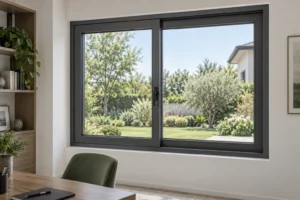
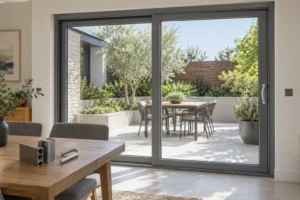
Sliding Doors feature one or more panels that glide horizontally along a track, providing easy operation and space-efficient opening for patios, balconies, and commercial entrances.
Engineering Specifications
Profile System Architecture
| Parameter | Standard Grade | Premium Grade | Testing Standard |
|---|---|---|---|
| Alloy | 6063-T5 | 6063-T6 | GB/T 5237 / EN 755 |
| Wall Thickness | 1.4-1.6mm | 1.8-2.5mm | ISO 1136 |
| Thermal Break | PA66 GF25, 20mm | PA66 GF25, 24-32mm | EN 14024 |
| Surface Coating | Powder coat ≥60μm | PVDF ≥30μm or anodized ≥15μm | AAMA 2603/2605 |
Sliding Door Frame Specifications
Thermal break aluminum 6063-T5/T6, 1.6-2.5mm wall thickness, PA66 GF25 thermal break, reinforced bottom track, multi-chamber thermal design, RAL color options
Performance Benchmarks
| Performance Metric | Standard | High Performance | Test Method |
|---|---|---|---|
| Air Permeability | ≤2.0 m³/m·h | ≤0.5 m³/m·h | EN 1026 / ASTM E283 |
| Water Tightness | ≥250 Pa | ≥600 Pa | EN 1027 / ASTM E331 |
| Wind Pressure Resistance | ≥2,500 Pa | ≥5,000 Pa | EN 12211 / ASTM E330 |
| Sound Reduction | 30-35 dB | 38-45 dB | ISO 10140 / ASTM E90 |
| Thermal Transmittance | 2.0-2.8 W/m²K | 0.6-1.4 W/m²K | EN 10077 / NFRC 100 |
Glass Engineering Details
Heavy-duty sliding rollers (nylon or stainless steel), multi-point locks (2-8 points), anti-lift blocks, flush pulls, EPDM weather seals, optional integrated insect screen and security bars
Lift-and-Slide vs Standard Sliding
| Feature | Standard Sliding | Lift-and-Slide |
|---|---|---|
| Operation | Slide on rollers | Lift handle, then slide on wheels |
| Seal Pressure | Constant compression | Seal releases when lifting |
| Effort | Moderate | Effortless (wheels bear weight) |
| Panel Weight | Up to 150kg | Up to 400kg |
| Air Tightness | Good | Excellent (higher seal pressure) |
| Price | Standard | +20-30% |
Anti-Lift Block — Why It Matters
Anti-lift blocks prevent the sliding panel from being lifted out of the track — a common security vulnerability in cheap sliding doors. Always specify this feature, especially for ground-floor installations.
Real-World Application Scenarios
Real-World Application Scenarios for Sliding Doors
Sliding Doors are the most popular door type worldwide — balancing ease of operation, space efficiency, and cost-effectiveness:
Patio & Garden Access: Sliding doors are the #1 choice for connecting indoor living spaces to patios, gardens, and pool areas. The space-saving operation (no swing clearance needed) makes them ideal for furniture placement near the door.
Balcony Access in Multi-Story Buildings: Outward-swinging doors on balconies create safety hazards and interfere with outdoor furniture. Sliding doors solve this while maintaining the view and natural light.
Commercial Storefronts: Large-format sliding doors provide easy access for high-traffic commercial entrances. Automatic sliding door operators integrate with access control and security systems.
Accessible Design: Sliding doors require minimal operating force, making them ideal for wheelchair-accessible entrances. Wide-panel configurations (up to 3,000mm) accommodate wheelchair passage without special hardware.
Maintenance & Long-Term Care
Maintenance & Long-Term Care for Sliding Doors
Roller Maintenance: Clean the bottom track quarterly and apply silicone spray to rollers annually. For lift-and-slide systems, check the lifting mechanism for smooth operation — stiff lifting indicates worn cam bearings.
Anti-Lift Block Check: The anti-lift block prevents the sliding panel from being lifted out of the track. Test annually by gently trying to lift the panel while it’s closed. If it lifts, adjust or replace the anti-lift block.
Lock & Handle Maintenance: Multi-point locks on sliding doors should be lubricated every 2 years. Check that all locking points engage fully — partial engagement compromises security.
Market Trends & Industry Insights
Global Market Trends
Sliding Doors represent the largest door segment by volume worldwide:
- Lift-and-slide premium segment growing 18% annually — heavy triple-glazed panels (up to 400kg) operated effortlessly via wheel-bearing mechanism
- Automatic integration — motorized sliding doors with smart home integration growing in luxury residential, not just commercial
- Slim sightline trend — architects demanding narrower frame profiles (as slim as 45mm visible frame) for maximum glass area
Manufacturing Quality Control — What Happens Inside the Factory
A professional sliding doors manufacturing process follows these stages:
- Profile receiving inspection — Hardness test, wall thickness measurement, surface quality check
- CNC cutting — Tolerance ±0.5mm, automatic angle optimization to minimize waste
- Thermal break rolling — PA66 strips crimped into profiles, pull-out force ≥2,400N
- Corner assembly — Corner cleats + EPDM glue injection + mechanical crimping (3-point)
- Hardware installation — Pre-drilled channels, torque-controlled screw driving
- Glass installation — Setting blocks, glazing gaskets, structural silicone (if specified)
- Sealing — EPDM gasket pressing, corner gasket welding, silicone sealant application
- Performance testing — Random sampling for water spray test, air infiltration test
- Final inspection — Dimension check, surface inspection, operation smoothness test
- Protective packaging — Corner protectors, EPE wrapping, wooden crate for export
Certifications and Compliance Matrix
| Certification | Region | Mandatory? | What It Covers |
|---|---|---|---|
| CE (EN 14351-1) | Europe | Yes | Performance, durability, safety |
| AS2047 | Australia | Yes | Structural, water, air performance |
| NFRC | North America | Energy codes | U-factor, SHGC, VT |
| ISO 9001 | Global | No (recommended) | Quality management system |
| SGS | Global | No (recommended) | Third-party product verification |
Understanding Test Reports — What the Numbers Mean
When evaluating sliding doors performance data, here’s what each test result tells you:
Air Permeability (EN 1026 / ASTM E283): Measures air leakage through the closed window. Lower values = better. Class 4 (≤3 m³/m·h) is suitable for most climates; Class 3 (≤6 m³/m·h) is acceptable for mild climates.
Water Tightness (EN 1027 / ASTM E331): Measures resistance to water penetration under wind-driven rain. Higher values = better. ≥600 Pa is recommended for coastal and high-rainfall areas; ≥250 Pa is acceptable for standard residential.
Wind Pressure Resistance (EN 12211 / ASTM E330): Measures structural strength under wind load. Higher values = better. ≥5,000 Pa for cyclone zones; ≥3,000 Pa for standard residential; ≥2,000 Pa for sheltered locations.
Sound Reduction (ISO 10140 / ASTM E90): Measured in decibels (dB). ≥35 dB for standard residential; ≥40 dB for noisy areas (highways, airports); ≥45 dB for professional-grade acoustic performance.
What Our Clients Say
> “After months of researching window suppliers, I chose Rogenilan for our beach house renovation. The PVDF-coated frames have held up beautifully against salt air — no corrosion after 18 months.”
Jennifer Walsh — High-End Homeowner, Private Residence, Malibu
> After months of researching window suppliers, I chose Rogenilan for our beach house renovation. The PVDF-coated frames have held up beautifully against salt air — no corrosion after 18 months. The laminated Low-E glass significantly reduced the ocean wind noise. The project manager sent weekly photos during production which gave me confidence throughout the process.
— Verified buyer testimonial, Usa market
Frequently Asked Questions
Q: What aluminum alloy grade should I specify for sliding doors?
A: 6063-T5 or 6063-T6 are the standard grades for architectural aluminum. T6 has higher tensile strength (≥205 MPa vs ≥160 MPa for T5) and is recommended for larger spans, high-wind zones, and structural applications. Always request the mill test certificate with your order.
Q: How thick should the thermal break strip be?
A: Minimum 20mm for standard climates, 24-32mm for cold climate or passive house projects. The strip should be PA66 GF25 (polyamide with 25% glass fiber) — not PVC, which has poor thermal performance and degrades over time.
Q: Can sliding doors meet passive house standards?
A: Yes, with the right configuration: thermal break ≥30mm, triple glazing with warm edge spacers, U-value ≤0.8 W/m²K, and airtight frame seals. We can provide PHPP calculation data for your specific project.
Q: Do you provide BIM models for sliding doors?
A: Yes — for commercial projects, we provide Revit family files and IFC models for all standard sliding doors configurations. This enables accurate BIM coordination and clash detection during the design phase. Custom BIM models for project-specific configurations are available upon request.
Q: How wide can a single sliding door panel be?
A: Standard maximum: 3,000mm wide. For wider openings, use multi-panel configurations. Maximum total opening: 12,000mm with 4+ panels.
Q: Can sliding doors be automated?
A: Yes — motorized sliding door operators are available for both standard and lift-and-slide systems. Integration with smart home systems and access control (keypad, card reader, biometric) is possible.
Ready to get started? Rogenilan manufactures premium Sliding Doors with CE, AS2047, and ISO 9001 certifications.
👉 Request a free quotation with your project specifications
👉 Explore our full product range
👉 Watch factory walkthrough videos
Article Tags: #SlidingDoors #AluminumWindows #BuildingMaterials #ChinaFactory #ConstructionProcurement #slidingglassdoorsSupplier
© 2026 Rogenilan — Professional Aluminum Windows & Doors Manufacturer | www.rogenilan.com